• About
    • Contact

    Hudson History

    • The Scottish Witchunts

      October 13th, 2023

      In the murky history of Stuart England, few topics are as bizarre as King James I’s obsession with witchcraft and demonolgy. During his reign witchunts surged in Britain and the scholar king known for translating the bible and for his support of William Shakespeare wrote a massive treatise on the dark arts: The Demonology of King James.  Yet James’s obsession with witchcraft wasnt just some weird fascination but the result of an incident early in his life that left a lasting fear of the dark arts in the scholar king.

      To Say James I of England and VI of Scotland had a rough childhood would be putting it lightly. James’s father Henry Stuart was murdered in a court plot when James was only one. His mother was Mary Queen of Scots who was forced to abdicated and later beheaded by Queen Elizabeth on dubios treason charges. This left the young orphan as King of Scotland at a young age and during his minority the country was governed by a council. 

      When James finally became King, he ruled as an absolute monarch in the Scottish tradition. In 1590, James traveled to Copenhagen, Denmark to marry his wife Anne of Denmark. Denmark at the time was fascinated with the dark arts – something that must have rubbed off on the young James. 

      During their return to Scotland the voyage was beset by storms. When James’s ships got to the River Forth, massive waves almost sank the ships almost killing the King and leaving Scotland without a monarch. 

      Back in Denmark witches were almost immediately blamed for the tempestous storms and multiple witches were condemned in Denmark. Back in Scotland, James started to blame witches for the near disaster and witchunts started like wildfire. The Scottish countryside was amuck with accusations and local officials hunting accused witches became commonplace. Those accused would face James himself for a trial starting a life long passion for witch hunting in the King.

      When accusations of witch craft reached North Berwick around Halloween in 1591, a local servant girl named Gillis Duncan was forced to confess to being part of a coven of witches in the area. This led to a massive panic and accusations against many locals. The witchunters soon focused in on a woman named Agnes Sampson – a local healer accused of being a Witch.

      Sampson was brought before James who questioned her and during an examination a birthmark was alleged to be a mark from the devil. After Torture, Sampson confessed that she ran a coven and had made a pack with Satan, alledging that he came to her in the form of an attractive man who fornicated with her.

      Samspon claimed that she cast a spell to raise a storm on the forth to kill King James. Needless to say, Samspon’s confession led to the rounding up of more suspected witches. As punishment for her alledged crime, Samspon was executed by burning so she could not return on Judgement day.

      The trial of Agnes Sampson and the Scottish Witch hunts of the 1590’s had a profound impact on Britain. After Queen Elizabeth I died, James became King of England thus being the first ruler to rule the entire British isles. James brought his fear of witches to England sparking the English Witch hunts that would later lead to the New England Witch hunts of the late 1600’s.

      This Post was Authored by Adam Danberg.

    • The Duc D’Anville Expedition

      August 18th, 2023

      Consign Boston To Flames…Ravage New England – these were the orders given to Louis Frederic de la Rouchfecauld de roye the Duc D’Anville by the French Command. The force sent by the French commanded by D’Anville was the largest military force sent to the New World until the American Revolution. News of the fleet sent panic throughout New England as fears of Catholic French Invasion gripped the colony. Yet, the expedition was a complete failure and is largely forgotten to history. In this article we will examining the Duc D’Anville expedition – the forgotten French Fleet. 

      In the 1740’s the American Colonies once again found themselves at war with France and her Indian allies. These conflicts had been going on for over half a century starting with King Williams War in 1688 and had periodically flared up, often with the advent of War in Europe. 

      When the War of the Austrian Succession broke out in Europe, Britain again found herself at war with France and subsequently, the American Colonies were now at war with The French in Canada and her Indian allies. To the Americans, the War was called King Georges War after the reigning British monarch George II. The colonists saw these wars as follies of the reigning monarch and named the wars after them (Hence King Williams War, Queen Anne’s War and King Georges War). 

      King Georges War is easily the most forgotten colonial war compared to Queen Annes War or King Williams War, both of which are filled with imfamous episodes like the Death of Major Waldron or the Raid on Deerfield. Most of the battles of the war were confined to Nova Scotia (known at the time as Acadia) where rival British and French colonies fought over supremacy.

      Some battles were fought in the colonies themselves, notably joint French and Indian raids in Upstate New York and Western Massachussetts. The big event of the war came when British and Colonial Forces lead by American Sir William Pepperrell besieged and captured the massive French Fort at Louisbourg. Both the story of Pepperrell and the Fall of Louisbourg deserve to be told in their own right, but the bottom line was that the largest French Fort in Acadia had fallen and the remainder of French Holdings in Acadia/Nova Scotia as well as all of Canada were now under threat.

      To relieve French Canada, King Louis XV of France tasked the Duc D’anville with a massive invasion fleet of 11,000 men and 64 ships set to recapture Nova Scotia. After Nova Scotia was under French control, D’anville was ordered to “Cosign Boston to Flames, Ravage New England and Waste the British West Indies”. In simple terms D’anvilles orders were to destroy British North America.

      Louis Frederic de la Rouchfocauld de roye, the Duc D’Anville

      News of the fleet sent panic through New York and New England both over fears of invasion and devastation, but also over fears that the Protestant colonies would be subject to the yoke of Catholic domination. Yet bad luck plagued the expedition from the start. Before the fleet was even out of port, the fleet was ravaged by storms in the Bay of Biscay. Then typhus and scurvy broke out in the ships. The disease ridden crew took three months to cross the Atlantic, during which storms wreck havoc on the ships with lightning even hitting a few.

      Two of D’Anville’s ships Le Mars and Le Raphael were set to return to France. The two got separated and Le Mars was captured in a duel by HMS Nottingham, an incident immortalized in the painting at the top of this article.

      By the time the fleet finally reached Nova Scotia, hundreds had died of disease and hundreds more were on their death bed. The expedition was planned in conjunction with a land assault from Quebec on the capitol of British Nova Scotia Annapolis Royal, but with news of the condition of the expedition the army began to withdraw. 

      With the fleet anchored in Halifax harbor and hundreds of men dying of disease, the Duc D’Anville died of a stroke. With the expedition in tatters D’Anville;s replacement sailed the remnants of the fleet back to France, thus ending the French threat.


      After this the French did not try again to reinforce their holdings in North America and the failure of the expedition would help push France to peace. In what was seen as a betrayal by many colonists, the Treaty of Aix-la-Chapelle which ended the War of the Austrian Succession including King George’s War restored all borders to pre war status, ceding all captured land in Nova Scotia back to the French. The failure to resolve the disputes on the continent would help lead to the advent of the French and Indian War less than 10 years later.


      The expedition while largely forgotten today was immortalized by Henry Wadsworth Longfellow’s poem A Ballad of the French Fleet. Further, the expedition has gained recent attention as the result of conspiracy theories regarding it suggested by the History Chanel discovery show the Curse of Oak Island, which suggests the expedition could have a part to play in the Oak Island mystery. Either way the expedition is part of a long forgotten history of colonial wars integral to America’s past.

      This Post was authored by Adam Danberg.

    • The Battle of the Margaretta & Jeremiah O’Brien

      August 5th, 2023

      In the American War of Independence, the naval war is often overlooked. When some engagement like John Paul Jones’s raids on England or the Battle of Chesapeake Bay are often studied, smaller engagements are overlooked. One such engagement is the Battle of Machias, dubbed the Lexington of the Sea by James Fenimore Cooper and the extraordinary career of the American commander Captain Jeremiah O’Brien.

      Jeremiah O’Brien was born circa 1740 in Kittery in what was then Massachusetts and is now Maine. His family were Irish immigrants who had come to Maine in pursuit of the lumber trade. O’Brien’s family settled in the down east port of Machias where O’Brien became a naval captain.

      When news of Lexington and Concord reached Machias, the towns people sided with the Patriot Cause and at the local tavern resolved to take action in support of the revolution. With Boston under siege by the Patriot militias, the British army was running out of provisions one of them being firewood. In order to resupply the British, local loyalist merchant Ichabod Jones agreed to send his two ships Polly and Unity full of wood to Boston. The British in return agreed to protect Jones’s ships with the six gun frigate Margaretta.

      Local Patriots lead by militia colonel Benjamin Foster and O’Brien decided to take action. Initially Foster planned to seize the British officers at church, but they escaped aboard the Margaretta. The local patriots then resolved to overtake the merchant ships and the Margaretta.

      In order to get the ammunition required, two young ladies, Hannah and Rebecca Weston traveled 16 miles to retrieve pewter silverware to make ammunition. Hannah was only 17 and pregnant with her first child at the time of her journey.

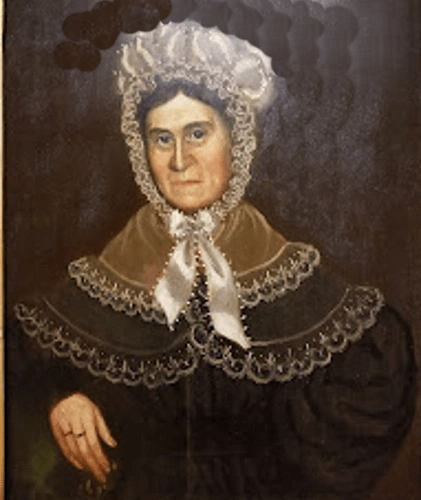
      Hannah Weston is pictured above in her old age. She lived to 97.

      With the ammunition ready, the patriots launched their assault. First O’Brien captured the Unity and turned it into his ship. From here the local patriots chased Margaretta, armed with pitchforks and hunting rifles. Fosters ship ran ground and could not pursue Margaretta, so the task was left up to O’Brien.

      O’Brien caught up with Margaretta and a fierce battle ensued. The Patriots fired into Margaretta’s hull and the Margaretta’s men threw grenades at O’Briens ship. Then a member of O’Briens crew mortally wounded the captain of Margaretta and his men were able to overpower the ship. It was the first time British colors were struck at the hands of Americans. For this the Battle of the Margaretta was dubbed the Lexington of the Sea by author James Fenimore Cooper.

      O’Brien would become a hero for his actions and would go on to lead a successful raid against Nova Scotia. O’Brien and his men would form a small fleet out of the captured ships that would protect the coast around Machias for the rest of the war. In 1777 the British attempted to take Machias, but were swiftly repelled by the towns men.

      O’Brien would go on to serve as customs collector for the Port of Machias and would die a hero in 1818. The Battle of the Margaretta would mark the first naval action of the War of Independence and would serve as a blow to British morale in the opening phases of the war at the hands of renegade Mainers.

      This Post was Written by Adam Danberg

    • FDR’s Cocktail Hours

      August 1st, 2023

      President Franklin Delano Roosevelt is arguably one of America’s greatest presidents leading the nation out of the great depression and leading America to victory over the Axis Powers in World War Two. To others he is a four term wannabe dictator who greatly expanded the federal government and is responsible for many of our country’s current problems. Yet one trivial fact about the man is often forgotten – he more than likely invented the dirty martini.

      On January 30th 1882, Franklin Delano Roosevelt was born in Hyde Park, New York a bucolic town in the Hudson Valley. He came from wealthy stock being descended from the Anglo-Dutch Nobility that once ruled New York. The political gene clearly ran in the family – his cousin Theodore from Manhattan would go on to be President from 1901 to 1909 and Franklin was distantly related to 8th President Martin Van Buren.

      FDR was destined his whole life to be a politician first running for New York Senate representing Dutchess county and winning an uphill victory. Next he was appointed assistant secretary of the navy by Woodrow Wilson overseeing much of the navy during World War One. This made FDR the natural democrat vice president nominee in 1920 (an election he lost in a landslide to Warren G. Harding). From there FDR would go on to become the governor of New York, narrowly winning a special election to replace Governor Al Smith.

      As governor of New York FDR would take decisive action to fight the great depression which made him a national figure propelling him to the 1932 democrat nomination where he beat Republican President Herbert Hoover in a landslide. One of FDR’s first acts as president was passing the 21st amendment which repealed prohibition. It is said that the first legal martini made after prohibition was made by FDR.

      Throughout his Presidency, FDR would use a cocktail hour ritual to escape from the trials of the Presidency. Many other World War Two world leaders had similar habits – Finnish Leader Marshal Carl Gustav Mannerheim would use elaborate dinners to distract from the war and British Prime Minister Winston Churchill would take long baths as well as enjoy whiskey and cigars to relax. Yet FDR’s cocktail hour took the trend to new heights.

      Roosevelt would do his cocktail hour ritual even when meeting with foreign leaders like Churchill and Stalin, often enjoying a drink with Churchill. During this time, FDR would forbid all conversation about the war and politics as a way to get away from the stress of the presidency for a few hours. 

      FDR’s drink of choice was either a dirty martini which many claim he invented, made with copious amounts of olive juice and a few drops of absinthe or the vintage tropical cocktail the Bermuda Rum Swizzle. Another favorite was a Manhattan made with Applejack, probably a nod to his Hudson Valley roots. He would always enjoy his drink with a cigarette and company of friends and family.

      FDR made his drinks with this asian motif cocktail shaker

      For Roosevelt, the cocktail hour provided a glimpse of normal life outside of the intensity of the Presidency as well as time to relax with family and friends. Unfortunately, FDR’s heavy smoking as well as his use of alcohol would deteriorate his health in the latter part of his presidency leading helping contribute to his demise in 1945.

      This Article was Written by Adam Danberg

    Blog at WordPress.com.


    Loading Comments...
     

      • Subscribe Subscribed
        • Hudson History
        • Already have a WordPress.com account? Log in now.
        • Hudson History
        • Subscribe Subscribed
        • Sign up
        • Log in
        • Report this content
        • View site in Reader
        • Manage subscriptions
        • Collapse this bar